Table of contents
Live sports betting has matured into a data-driven arena where odds flicker in response to every pass, foul and timeout, and where millions of micro-decisions made by bettors leave measurable traces. Over the past few years, regulators, integrity units and research teams have increasingly focused on those traces, because patterns in in-play markets can reveal everything from human bias to suspicious manipulation. What emerges, when you line up the numbers, is less a story of lucky hunches and more a map of predictable behavior, punctuated by rare but telling anomalies.
Odds move fast, but humans lag
Here is the core tension of live betting: pricing updates in seconds, while people process in moments. Major bookmakers now stream automated, model-led prices that react to match events almost immediately, and that speed has only increased as official data partnerships have expanded across leagues and sports. Sportradar, one of the largest sports data providers, reported 63 billion data points collected in 2023, a scale that underpins real-time odds compilation and risk monitoring across global markets, and it helps explain why the “window” for beating a widely available price has narrowed sharply.
Yet bettors continue to behave as if the window is wider than it is, and that gap shows up in the data. Academic work on in-play wagering repeatedly finds evidence of classic behavioral biases amplified by the live format, including overreaction to salient moments, and underweighting of base rates. In soccer, for example, markets tend to swing heavily after a goal, even though the pre-goal game state and team strength still matter, and in tennis, streaks can look more meaningful to spectators than to models that already price momentum indirectly through player quality and context. The result is a recurring pattern: volume surges immediately after major events, while prices often become less favorable for late clickers because the model has already moved.
That lag is also visible around information delays. Even with official feeds, broadcast latency can be several seconds, and integrity guidance has long emphasized that courtsiding and faster data access can create unfair advantages. The International Tennis Integrity Agency, in its annual reporting and operational updates, has highlighted the centrality of live betting to modern integrity work, and tennis remains a case study because point-by-point markets are particularly sensitive to who knows what, and when. For the ordinary bettor, the data tends to show the same story over time: live markets reward preparation and discipline more than reflex, because by the time a “moment” feels obvious, the price usually reflects it.
When the crowd piles in, prices distort
Sharp money is not the only force shaping in-play lines, and in some sports it is not even the dominant one. In high-profile matches, especially where recreational interest is concentrated, the “weight of money” effect can tilt pricing as operators manage risk, and that produces distortions that are measurable, and sometimes repeatable. Studies of betting-market efficiency have long examined how favorites and underdogs are priced, and one of the most persistent findings across eras is the favorite-longshot bias, where longshots can be systematically overbet relative to their true chances, while favorites can offer slightly better value, depending on the market and the margin.
Live betting can intensify that bias because bettors are reacting to narrative, not just probability. A team “looking dangerous” without scoring, a star player “taking over,” a perceived momentum swing, all of it can drive spikes of action that nudge odds away from model-only estimates as traders balance books and protect against correlated exposure. The crowd, in other words, can move the market even if the underlying probability has not changed much, and that is especially true in markets with many casual participants, such as big soccer derbies or NBA playoff games. Regulators and industry bodies have increasingly pointed to the scale of online betting to contextualize these effects; the UK Gambling Commission, for instance, reported gross gambling yield for remote betting of £2.6 billion in the year to March 2024, underlining how much activity now flows through online channels where live markets are a centerpiece.
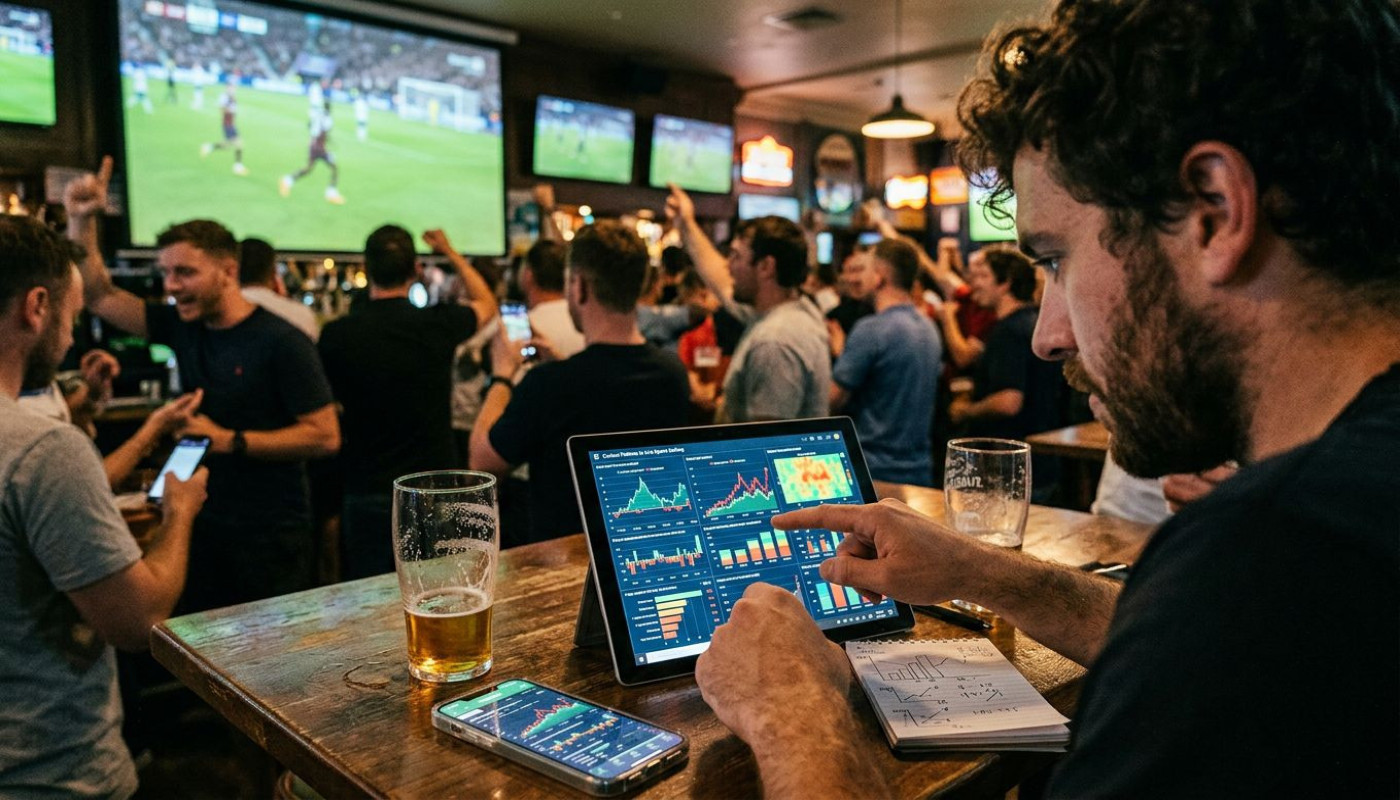
There is also a structural reason distortions can linger: live products are designed for engagement, not just for price discovery. Short settlement cycles and constant opportunities to bet encourage higher turnover, and that can sustain patterns like chasing losses, escalating stakes late in games, and concentrating bets in “high-drama” windows. Those behaviors are not random; they cluster by match minute, by scoreline and by the psychological impact of recent events. If you chart bet frequency against game time, the curve often rises as the end approaches, and it spikes again in overtime scenarios, a dynamic that makes sense emotionally, even when it is mathematically harsh because margins and volatility increase.
Integrity teams watch the same signals
Not every unusual pattern is suspicious, but integrity analysts treat anomalies as prompts, not proof. Across sports, a classic red flag is a divergence between what happens on the field and what happens in the market: sudden, disproportionate movement in niche in-play markets, unexpected volume on lower-profile events, or repeated anomalies tied to a particular player, team or competition. The International Betting Integrity Association, which represents many regulated operators and aggregates alerting data, reported 184 suspicious betting alerts in 2023, a figure often cited to illustrate both the scale of monitoring and the fact that suspicious signals are a small fraction of total activity.
Live betting generates a particularly rich set of signals because it is time-stamped, granular and sensitive to micro-events. If a market moves sharply before a visible incident, analysts may ask whether there was a data feed issue, an injury seen earlier in the stadium than on broadcast, or a genuine integrity concern. In sports with frequent stoppages, like basketball, unusually coordinated betting during timeouts can stand out; in soccer, attention often falls on specific incidents, such as penalties, red cards and unusual late-game sequences. Monitoring also extends beyond price moves to bet placement patterns, including account clustering, stake sizing, and the use of correlated markets that can amplify exposure.
Regulatory frameworks increasingly push operators to document these processes, and to share intelligence. The UK Gambling Commission’s approach, for example, emphasizes risk management, customer protections and reporting obligations, while sports integrity units work to connect betting anomalies with investigative leads. What the data reveals, again and again, is that the most useful integrity work is comparative: analysts benchmark an event against historical baselines for that league, that referee, that player and that specific market type. A sudden spike is far more meaningful when it is abnormal for that competition, and not merely “big” in absolute terms.
For bettors, this matters for a simpler reason: the cleaner the ecosystem, the more trustworthy the price. In a market where integrity alerts are acted on, where data feeds are robust, and where suspicious activity is deterred, live odds are more likely to reflect real probabilities rather than hidden information. That is why the industry’s attention to monitoring has grown alongside live betting’s rise, and why the conversation has shifted from whether anomalies exist to how quickly they can be detected and contextualized.
Personalization reshapes risk, and behavior
Live betting is no longer a one-size product. Operators increasingly tailor offers, limits and experiences based on customer profiles, and that personalization changes both risk and behavior in ways the data can capture. Some bettors see more prompts to place micro-bets, others face tighter staking limits, and many encounter interface designs that nudge them toward quicker decisions. This is not speculation; it is a widely observed direction of travel in digital platforms, and gambling is no exception, with responsible gambling frameworks, affordability discussions and product design scrutiny all rising in parallel.
Personalization also intersects with regulation, particularly around self-exclusion. In the UK, GAMSTOP is the national multi-operator self-exclusion scheme, designed to block access to participating online gambling services for those who register. At the same time, search interest in alternatives remains high, and readers frequently encounter listings or guides about casinos not on GAMSTOP, a phrase that reflects a real segment of the online market and a complex policy debate about consumer protection, cross-border access and harm reduction. The data footprint of that debate shows up in traffic patterns, in affiliate ecosystems and in the way gambling choices fragment across jurisdictions and licensing regimes.
From a behavioral perspective, fragmentation can matter because it changes the feedback loop that shapes live betting habits. Self-exclusion tools, deposit limits and reality checks can dampen impulsive in-play staking, while unrestricted environments may do the opposite, and researchers and regulators increasingly focus on how product intensity interacts with vulnerability. The UK Gambling Commission has repeatedly emphasized the importance of customer-led tools and operator safeguards, and the broader European discussion has moved toward tighter advertising rules, stronger verification and more robust harm-prevention measures. For the reader trying to make sense of the numbers, the practical takeaway is that the “patterns” in live betting are not only about sports, they are also about design, access and guardrails, all of which influence how frequently people bet, when they escalate and whether they can step away.
Planning your bets, and your limits
Before placing live bets, set a budget, stick to fixed stakes and decide in advance when you will stop. If you use self-exclusion or deposit limits, activate them early, because they work best before emotions take over. For major events, consider timing: odds often worsen right after big moments, and value is rarer in the surge.
Similar


